

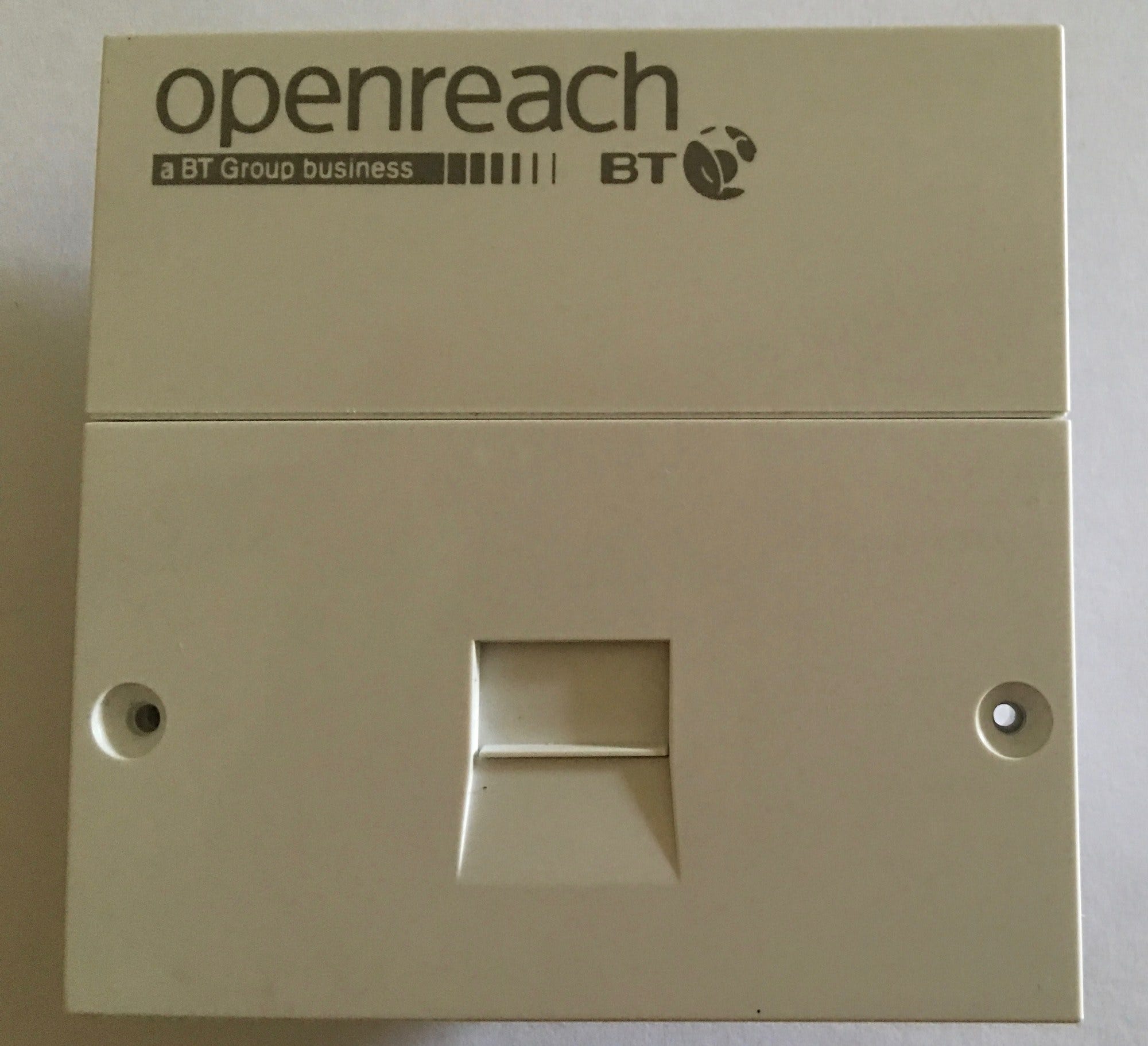
(Landlineman links to https://commons.wikimedia.org/wiki/File:BT_NTE5A.jpg and CC BY 4.0 links to https://creativecommons.org/licenses/by/4.0/)

The kettle’s on
Openreach has started a countdown. Last Friday it warned that fewer than 100 days remain before the old copper phone network closes for good. Your desk phones are probably fine. It’s the PDQ machine in the corner that should be nervous.
The big one
It’s not the desk phones. It’s the card machine and ancillary devices
On Friday 30 October Openreach said about one million lines still rely on the old analogue network, the PSTN (Public Switched Telephone Network). Some 300,000 are in business premises, and London and the South East has more of these lines than any other region: 250,473. The network closes on Sunday 31 January 2027, 88 days from now. The easy switches are mostly done, Openreach says. What’s left is the kit nobody thinks of as a phone, such as old machines, alarm panels that report to a monitoring centre, door entry, automated gates and lift emergency phones.
Waiting costs money, too. Openreach says rental on these lines has doubled compared with 2025, with more rises planned from February 2027. Lines that haven’t moved by the deadline may be shifted to EVAc (Emergency Voice Access), a stopgap for essential calls that Openreach calls “temporary, limited and more expensive than modern alternatives”.
Why it matters at your size
Most firms of twenty plus employees moved their desk phones to internet calling years ago. The line that’s left is the one nobody remembers paying for, running the burglar alarm that dials out, the door entry panel, in fact there may well be legacy systems with line connections which won’t be noticed, none of these sends a warning. You find out when a customer’s card won’t go through, or when the alarm company stops receiving signals or manufacturing or monitoring systems fault.
The fixes come from different people: the alarm company, the factory equipment manufacturer, the landlord. Each works to its own timetable, so we’d start this week rather than wait to join the scuffle in January.
Do this (under an hour)
Walk round the office and and other area’s including stores and manufacturing or workshop areas and note everything plugged into a phone wall socket, or any line which you cannot identify. Get your IT team to provide an up to date list of any PSTN lines in use in the comms room and rack(s) and then check your phone bills (there are likely to be more than one) for anything described as analogue, PSTN, WLR (Wholesale Line Rental) or plain “line rental”, and match each line to something on your list. Email each supplier one question: “Does this still use the old phone network, and when will you move it?” Get the date in writing. Sharing a building? Ask the landlord the same about the lift phone and door entry.
From the helpdesk
The forgotten phone line
During a routine review of a customer’s IT and telephone services, an old analogue line was discovered that nobody could account for. The business had moved to internet-based telephones years earlier, so everyone assumed the old lines were no longer needed.
Further investigation revealed that the line was still connected to the building’s burglar alarm, allowing it to communicate with the alarm monitoring centre.
Had the line simply been disconnected, the business could have lost an important part of its security without realising.
It’s a useful reminder that just because your phones have gone digital doesn’t mean everything else has.
Three other things worth knowing
The cyber security bill clears the Lords
The Cyber Security and Resilience Bill finished its House of Lords stages on Monday 2 November and returns to MPs with two government defeats attached. Suppliers to essential services such as healthcare and energy should expect security questions from customers.
Copilot billing changes on 1 December
From Tuesday 1 December, new Microsoft 365 Copilot Business licences bought through a partner have pay-as-you-go charges switched on, capped by default at 4,000 Copilot Credits per user per month. Ask whoever buys your licences what that cap means in pounds, and more importantly how much you will be paying.
Deepfake investment scams took £24.3 million
Report Fraud says fake investment schemes using artificial intelligence (AI), including deepfake videos of famous faces, took £24.3 million from January to August 2026. Nearly 80 per cent of reports came from people aged 60 or over, so tell older relatives to check any firm on the Financial Conduct Authority (FCA) Firm Checker first.
Jargon jar: SOGEA
Short for Single Order Generic Ethernet Access, which tells you engineers named it. It’s a broadband line with no old-style phone line attached, so calls travel over the internet instead. Think of it as keeping the road and lifting the tram tracks.
Where are they now? Cisco
Cisco was founded on 10 December 1984 by Len Bosack and Sandy Lerner, a married couple who had been computer scientists at Stanford University. Trying to get email between computers on different networks, they ended up inventing the first multiprotocol router, a box that lets different networks talk to each other. Early networking devices were called bridges, so the first logo, in 1985, was a stylised Golden Gate Bridge, which Bosack worked out with parabolic equations. In 2012 Cisco paid about $1.2 billion for Meraki, whose network kit is run from the cloud rather than a cupboard. The box blinking under your desk owes a lot to an email that wouldn’t arrive.
The diary
Friday 13 November, 5pm: consultation closes on the Competition and Markets Authority (CMA) plan to give Microsoft “strategic market status” for its business software, which would let the regulator set conduct rules.
Sunday 31 January 2027: the copper phone network closes.
One thing to do
Not sure which of your lines still use the old network? Book a free 15-minute call with your phone bill to hand and we’ll tell you plainly what needs to move.
Sign-off
Hit reply and tell us the oddest thing you find plugged into a phone socket, if you are actually still using the service and if not, was it a forgotten connection or an important service that you were likely to lose?
Until next week. If something in a cupboard has been quietly dialling out since the last century, do tell us.
Tracy Wright - 360ict - Having worked in the technology sector since the advent of the PC, she has spent the past 20 years strategically advising IT and telecoms companies serving UK SMEs. A business management graduate, she brings a practical business perspective to technology—cutting through the jargon with plain-English tech news for SMEs —helping business owners understand what matters and why.